Course Structure
Structure
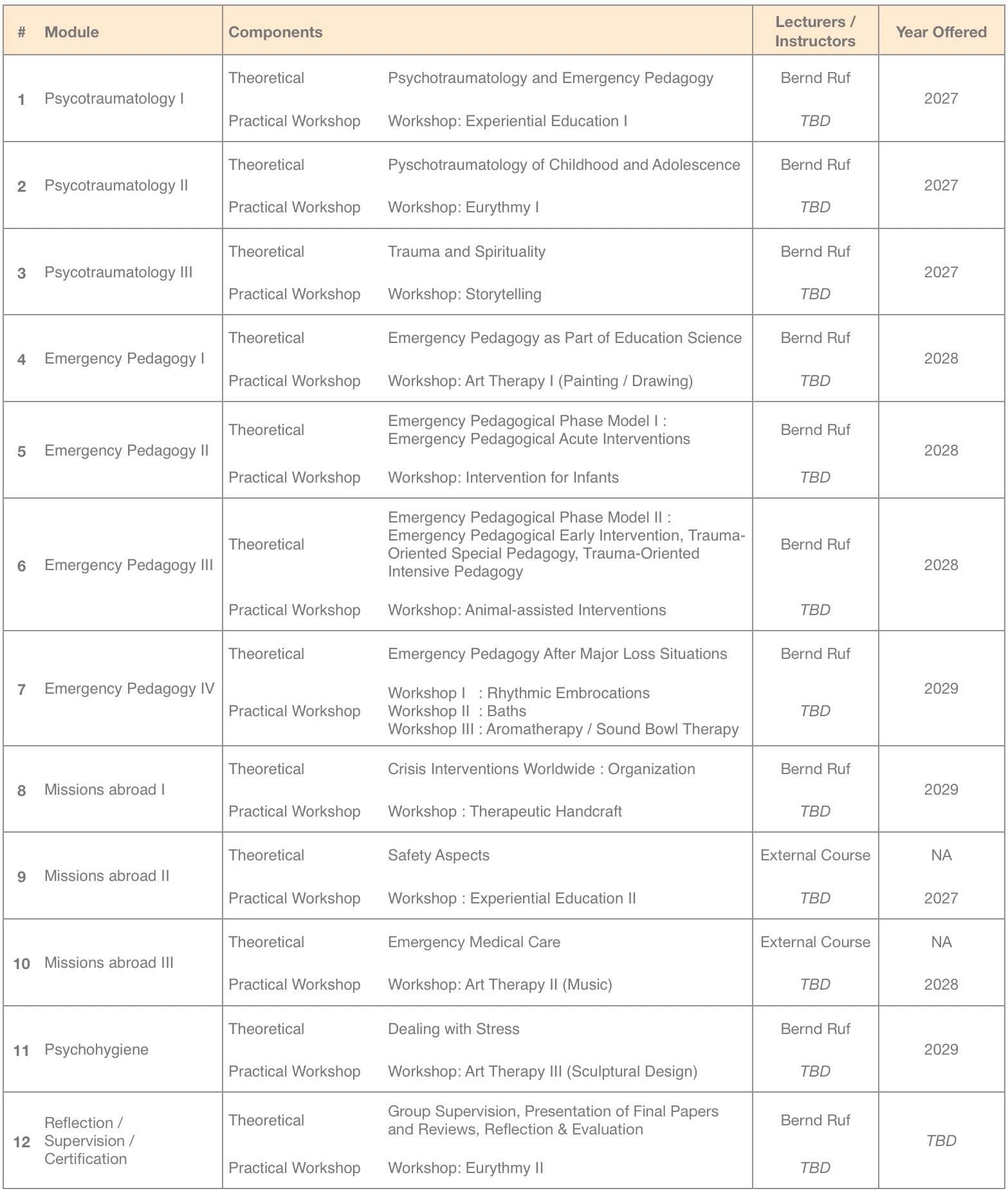
Our course has a modular structure of 12 modules. After completing the basic module (Introduction to Psychotraumatology), the remaining modules may be taken in any order, offering flexibility. Each module combines theoretical input with practical training. Successful completion of an individual module leads to a module certificate; completion of all 12 modules leads to a full certificate.
Key Theoretical Components
- Introduction to the basics of psychotraumatology
- Introduction to the basics and intervention techniques of Emergency Pedagogy
- Organisational structure for the preparation, implementation and follow-up of emergency pedagogical missions abroad
- Basics of psychohygiene, self-protection and self-care
Practical Components
- Training in emergency pedagogical intervention techniques
- Safety training
- Training in emergency medical care
Reflection, Supervision & Evaluation
- Regular reflection and evaluation take place at the end of each module. Supervision is conducted in a group setting.
Certification Requirements
- Regular participation
- Written final thesis
- Oral presentation of the thesis
The training prepares participants to provide early pedagogical support that stabilises children and adolescents after traumatic events and activates their self-healing capacities.
This is a structured three-year professional training programme in Emergency Pedagogy. Participants attend one continuous intensive week each year, during which three to four modules are delivered. Every module integrates both theoretical foundations and practical application, ensuring a balanced development of knowledge and skills.
For Modules 9 and 10, the theoretical components are completed through recognised external professional courses. A list of recommended courses is provided to guide participants in fulfilling these requirements.
Module 12 is the culminating component of the programme and may only be undertaken after successful completion of Modules 1–11. Fulfilment of all twelve modules constitutes completion of the professional certification process. Details regarding the scheduling and delivery of Module 12 will be announced at a later date.
Our modular advanced training is certified by:
- The Free University of Education in Stuttgart, Germany
- The Medical Section at the Goetheanum in Dornach, Switzerland